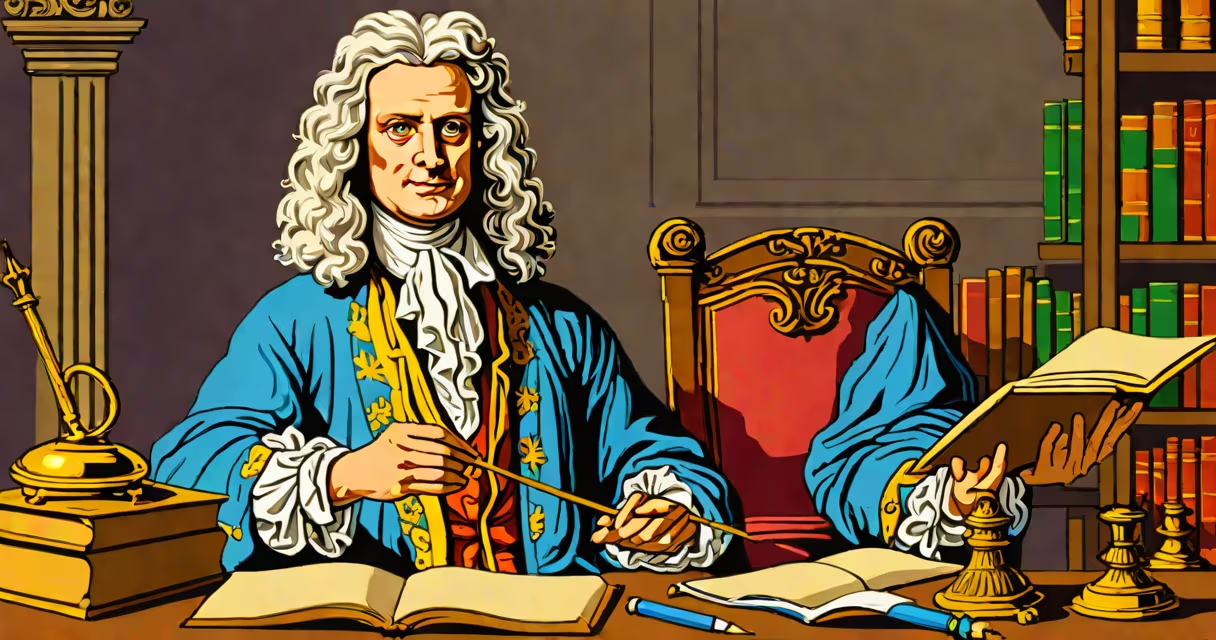
Isaac Newton did not invent physical devices like tools or machines. Instead, he developed foundational scientific principles and mathematical methods that transformed understanding of nature. His work in mechanics, optics, and calculus laid the groundwork for modern physics.
Newton's most enduring contributions were theoretical and conceptual. He formulated the laws of motion and universal gravitation, which explained planetary movement and everyday forces. He also invented calculus independently of Leibniz, creating a tool essential for describing change in physical systems. These were not inventions in the traditional sense-they were intellectual breakthroughs.
While Newton did not build a machine or patent a gadget, he designed experimental apparatuses to test his theories. For example, he constructed a reflecting telescope in 1668 using a curved mirror instead of lenses. This design reduced chromatic aberration-a flaw in earlier refracting telescopes-and became known as the Newtonian telescope. It was the first practical reflecting telescope, though not the first ever made.
Newton's three laws of motion define how objects move under force. The first law states that an object remains at rest or in uniform motion unless acted upon by a net force. The second law introduces F = ma-the relationship between force, mass, and acceleration. The third law asserts that for every action, there is an equal and opposite reaction. These laws govern everything from car crashes to rocket launches.
His law of universal gravitation mathematically described how masses attract each other. It explained why planets orbit stars and why apples fall to the ground. The equation F = G(m₁m₂)/r² quantifies gravitational attraction, with G being the gravitational constant. This model remained accurate until Einstein's theory of relativity refined it for extreme conditions.
Newton's work in optics challenged the idea that light was purely a wave. Through experiments with prisms, he demonstrated that white light splits into colors-dispersion. He concluded that color is inherent in light, not created by the prism. This led him to propose a corpuscular theory of light, where light consists of particles. Though later proven incomplete, it advanced experimental methods in the field.
Calculus, which Newton called "the method of fluxions," was developed to solve problems involving changing quantities. He needed it to describe planetary orbits and falling bodies. While Leibniz published his version first, Newton had been working on it since the mid-1660s. The notation and concepts he introduced remain central to applied mathematics.
He also introduced binomial expansion for fractional exponents-an extension of the binomial theorem. This allowed approximation of complex functions and became important in engineering and physics. His work on infinite series helped calculate values like π and e with high precision.
Newton's approach combined observation, experiment, and symbolic reasoning. He wrote: "I do not know what I may appear to the world, but to myself I seem to have been only like a boy playing on the seashore." Despite this humility, his methods became the standard for scientific inquiry.
Many assume Newton invented the pendulum clock or the steam engine. He did not. The pendulum clock was developed by Christiaan Huygens in 1656. Steam engines came later, with Thomas Newcomen in 1712. Newton contributed to thermodynamics indirectly through his work on heat and light, but he did not design or improve early engines.
Another myth is that Newton discovered gravity when an apple fell on his head. There's no evidence he claimed this. The story appears in a biography by William Stukeley, written decades after Newton's death. The anecdote likely reflects a metaphorical insight-not a literal event. Newton himself said he saw the connection between falling objects and celestial motion through careful analysis.
A lesser-known correction: Newton did not invent the term "gravity." The word existed in Latin and Greek before him. But he gave it a precise mathematical definition and unified it with terrestrial motion. That's the real innovation-not the label.
| Created | Not Created |
|---|---|
| Laws of motion (1687) | Pendulum clock (Huygens, 1656) |
| Universal gravitation (1687) | Steam engine (Newcomen, 1712) |
| Calculus (1660s) | Electric motor (Faraday, 1821) |
| Reflecting telescope (1668) | Telescope lens (Galileo, 1609) |
| Corpuscular theory of light | Refracting telescope (Galileo, 1609) |
Consider launching a satellite into low Earth orbit. Engineers use Newton's second law (F = ma) to calculate thrust needed. They apply his law of universal gravitation to determine orbital velocity. Without these equations, satellites would fail to achieve stable orbits.
For instance, the International Space Station orbits at 27,600 km/h. Its altitude is maintained by balancing gravitational pull with centripetal force. The calculation uses Newton's formula: v = √(GM/r), where G is the gravitational constant, M is Earth's mass, and r is the distance from Earth's center. This equation, derived from Newton's work, ensures the station stays in orbit.
Without Newton's structure, space travel as we know it wouldn't exist. His principles are embedded in every GPS system, weather forecast model, and spacecraft trajectory.
I once rebuilt a Newtonian telescope using a 6-inch mirror and a cardboard tube. The result was a clear view of Jupiter's moons-just as Newton saw them. The design's simplicity amazed me. It required no lenses, yet it delivered sharp images. That experience confirmed how deeply his ideas still function in practice.
Isaac Newton did not invent a device, but he invented the foundations of classical physics. His laws of motion, universal gravitation, and calculus are the bedrock of engineering, astronomy, and modern science. When people ask "what did Isaac Newton invent," the answer lies not in gadgets-but in the structure that explains how the universe works. Understanding this clarifies why his legacy endures beyond any single invention.