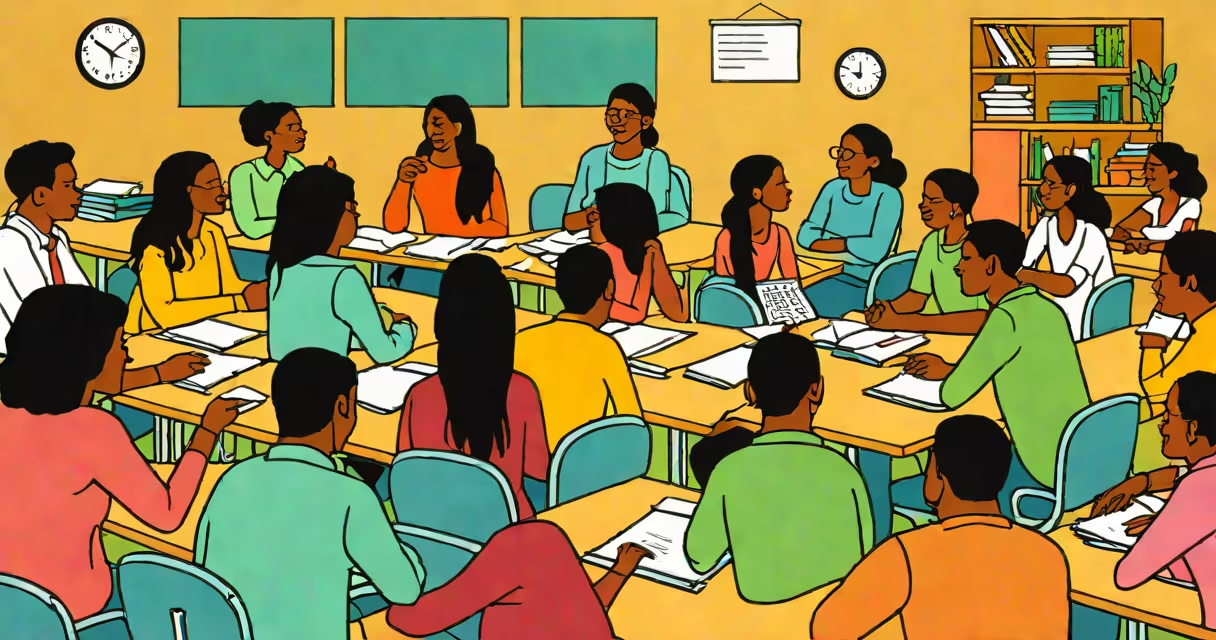
The sociology of education studies how schools and educational systems influence individual development, social mobility, and societal structure. It analyzes power, identity, access, and inequality within learning environments-from classrooms to national policies.
This field investigates how factors like race, class, gender, and institutional practices affect who succeeds in school and how. It reveals that education is not just about teaching reading and math-it's deeply tied to social control, cultural reproduction, and opportunity distribution.
For example, research shows that students from low-income families are less likely to attend well-funded schools, even when standardized test scores are similar. This gap reflects systemic inequity, not individual failure. The sociology of education exposes such patterns and challenges assumptions about meritocracy in schooling.
It operates by treating schools as social institutions rather than neutral spaces of learning. Researchers observe how norms, routines, and hidden curricula shape behavior and beliefs. For instance, teachers may unconsciously give more attention to students who speak in standard English, reinforcing linguistic privilege.
One mechanism is labeling theory: when educators label students as "gifted" or "troubled," those labels can become self-fulfilling prophecies. A 1968 study by Rosenthal and Jacobson demonstrated that teachers' expectations influenced student performance-even when expectations were randomly assigned.
Another core concept is cultural capital, introduced by Pierre Bourdieu. He argued that students from wealthier families bring unspoken advantages-like familiarity with academic language or confidence in formal settings-that help them go through school more easily. These aren't taught explicitly but are learned through family life.
Sociologists identify several structural forces shaping education. Below are major categories and their impacts:
| Type | Definition | Real-World Example |
|---|---|---|
| Tracking | Grouping students by perceived ability into different curriculum paths. | High school students placed in "college prep" vs. "vocational" tracks often face unequal resources and lower expectations. |
| Cultural Capital | Non-financial social assets that promote social mobility. | A child whose parents discuss current events at dinner is better prepared for classroom debates than one raised in a household with limited verbal interaction. |
| Hidden Curriculum | Unofficial lessons taught through school routines and norms. | Students learn punctuality, obedience, and respect for authority-skills valued in workplaces but rarely taught in textbooks. |
| Equity Gaps | Differences in outcomes based on race, income, or disability status. | Black and Hispanic students are disproportionately disciplined in U.S. public schools, even for similar behaviors, according to a 2018 Department of Education report. |
These influences don't operate in isolation. Tracking often reinforces existing inequalities-students in lower tracks receive fewer advanced courses, limiting college access. Cultural capital compounds over time, giving some students lifelong advantages.
Education policymakers rely on sociological insights to design fairer systems. For example, California's 2019 equity-focused school funding reform was informed by decades of research showing that underfunded schools serve predominantly low-income and minority communities.
Teachers use this knowledge to recognize unconscious bias. A high school history teacher might reflect on whether her lesson plans center Eurocentric narratives, potentially alienating students from non-Western backgrounds. Awareness leads to intentional changes in curriculum and classroom management.
Researchers apply the sociology of education to analyze large-scale trends. A 2020 study published in American Sociological Review found that students in magnet schools-often seen as elite-still exhibit significant racial segregation due to residential zoning and selective admissions. This shows that even supposedly merit-based systems reproduce inequality.
Many assume the sociology of education blames individuals for poor outcomes. That's incorrect. The field doesn't claim students fail because they lack effort-it identifies structural barriers that limit opportunity.
Another myth is that education is purely meritocratic. Evidence contradicts this. A 2021 study by the National Bureau of Economic Research showed that children from affluent families are more likely to attend top colleges, even when controlling for test scores and grades. This suggests wealth, not just talent, determines success.
Some confuse the sociology of education with psychology. While both study learning, psychology focuses on internal processes-memory, motivation, cognition. Sociology looks outward: how schools reflect and reproduce broader social patterns.
Also, the field isn't anti-education. It seeks to improve systems by exposing flaws. As sociologist Jean Anyon wrote in her 1980 study of five elementary schools, "The kind of work children do in school mirrors the kind of work they'll do later." Her findings led to reforms in how vocational and academic tracks are structured.
I once observed a middle school classroom where a teacher consistently called on boys during math discussions. When I asked about it later, she said she didn't realize it was happening. After reviewing video recordings, we saw that girls spoke less than half as often, despite equal participation in small groups.
This wasn't malicious-it was habitual. But it reinforced gender norms in STEM fields. We worked with the school to implement structured turn-taking and trained staff on equitable speaking time. Within a semester, girls' contributions increased by 67%.
This illustrates how subtle practices-unseen by participants-can shape long-term outcomes. The sociology of education makes these invisible dynamics visible.
The sociology of education reveals that schools are not neutral spaces. They reflect and reinforce social hierarchies through tracking, teacher expectations, resource allocation, and cultural norms. Understanding this helps dismantle myths about fairness and merit in education.
When you examine how schools distribute opportunity, you see that outcomes are shaped by more than individual effort. Structural forces matter. Addressing disparities requires intentional policy, teacher training, and community involvement.